


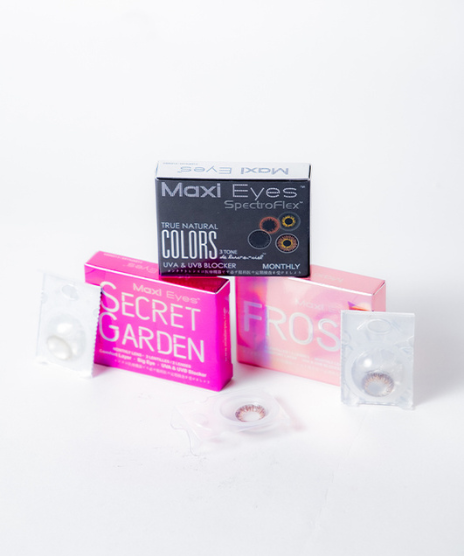







What happens during a contact lens fitting?
Most first-time wearers assume the process is simple: get your grade, buy lenses in that grade, done. It is not, and the gap between those two things is the reason a lot of people conclude that contact lenses are uncomfortable when really they were wearing the wrong ones.
A fitting measures your eye. A prescription only measures your vision.
Why your eyeglass grade is not enough
A spectacle lens sits about twelve millimetres in front of your eye. A contact lens sits directly on it. That distance changes the effective power, which is why stronger prescriptions often need a different number on a contact lens than on glasses.
More importantly, a contact lens has to physically fit a curved, living surface. Two people with identical grades can have corneas of different sizes and curvatures. A lens that is too tight restricts movement and starves the surface of oxygen and tear exchange. A lens that is too loose slides, blurs on blinking, and edges off centre. Neither problem is visible in a grade.
The appointment, step by step
- A conversation first. What you want the lenses for — daily wear, sport, occasional use, an event — how many hours a day, and your health history. Some medications and conditions change what is suitable.
- A full eye exam. The refraction gives your current correction. This is the same measurement work as a standard eye test and needs to be current.
- Measurements of the eye surface. The curvature of your cornea and the size of the visible part of your eye. These determine the base curve and diameter of the lens — the two numbers on a contact lens box that are not on your glasses prescription.
- Assessment of your tear film. Contact lenses sit in your tears. If your eyes already run dry, that shapes the material and the wearing schedule you are given.
- A trial pair. You wear an actual lens. The optometrist checks how it centres, how far it moves when you blink, and how your vision holds. Adjustments happen here rather than after you have bought three months of stock.
- Handling lessons. Insertion, removal, and cleaning, practised until you can do it yourself. For most first-timers this is the longest part of the visit, and it is the part that decides whether the lenses get worn.
- A follow-up. A check after you have worn them in real conditions — real hours, real aircon, real commute.
Set aside more time than a routine eye test. Handling practice alone can take a while on a first fitting, and that is normal.
How to prepare
- Come with clean hands and short, clean nails — you will be touching your own eye
- Skip heavy eye makeup that day
- Bring your current glasses and any previous prescription
- If you already wear contact lenses and want a different type, ask when to stop wearing them before the visit — lenses can temporarily change the shape of the cornea and affect the measurements
- Bring your glasses regardless. You will need something to see with on the way home if your eyes have had enough
You still need glasses
Every contact lens wearer needs a current pair of glasses. Not as a backup for lost lenses — as a requirement. Eyes need time out of lenses, and any day with irritation, redness or infection is a day you must not wear them. Without glasses, people wear lenses through symptoms they should be resting, which is how small problems become serious ones.
Book a Vision7 eye test at your nearest Vision Express store
Start with our seven-step comprehensive eye exam and tell the team you are interested in contact lenses. The visual health exam assesses the front surface of your eye and your tear film, which is what determines whether lenses suit you and which type — and the refraction steps give the accurate baseline a fitting is built on. The fitting itself is booked with an optometrist in store.
Ask for Essilor Blue Light Single Vision at the counter for the glasses that go alongside them. This is the pair you wear on lens-free evenings and on any day your eyes need a break, and the blue light option means those hours in front of a screen are comfortable rather than something you rush through to get the lenses back in.
If you need that pair the same day, ask about Opulens Advanced 1.60 — in stock and ready in 20 minutes.
Every pair comes with free lifetime ultrasonic cleaning, free lifetime custom fitting and adjustment, and a 1-year warranty.


Leave a Comment